
In this fast-paced moment, sustainability and finance teams have a choice. Take a look at our 5 hidden costs of sustainability data preparation that blow up timelines and budgets. Don’t fly blind!
1. Data entry is just the start.
Data QA will cost you 3-5X more.
Humans make errors when typing in data. And these errors can be hard to find. Most companies must do two rounds of data QA, with each round using increasingly more expensive senior managers. Typical data QA costs are much higher than the cost of data entry itself.
2. Compliance is expensive.
And it goes up every year.
External assurance and audits go beyond simple accuracy tests. They focus on the method of reliably preparing sustainability data – the entire system. Data about the costs of compliance for financial reporting shows an average annual spend of $1.6M for 350 controls. Assuming sustainability has 125 controls (GLYNT’s experience), you’ll be spending $350K each year for a compliant in-house sustainability data preparation system.
3. Reduction plans need 10X more data than baseline reports.
Reviewing one PDF at a time breaks timelines and budgets.
Baseline reporting is often high-level, such as total energy use per site. Complex utility bills are reduced to a single usage number. Manual data entry and enhanced OCR tackle one invoice at a time, which seems doable when there are 10 high-level fields per invoice. But reduction planning needs detailed data on how and where energy is used – which is up to 125 fields per invoice. Without this data, you can’t make the budget case for reductions. And at 125 fields per invoice one-at-a-time reviews stall. It’s not just more data, it is all that utility jargon – no one on the data entry team knows what it really means! Standard invoice processing from AP systems have high exception rates for utility bills and fail to capture much beyond the header and payment info.
4. Investors will be able to see up to 1000 sustainability data points on each company for over 75,000 companies. It’s a new level of scrutiny and disclosure risk.
Investors use sustainability data to select stocks (see our research roundup). Bloomberg terminals, Moody’s and MSCI are set up to display sustainability data as it is reported, and CDP will be sending data on 75,000 companies to these systems in 2024. Investors tie financial data, sustainability data and climate risk data into a single profile and scrutinize it with a powerful AI toolkit. So every data point you release is exposed. Without a rigorous data preparation system, the automated, high-velocity scrutiny will find the errors, and your CFO will have to walk them back. The cost is legal challenges, hits on valuation and stalls in raising capital.
5. AI is the future, and data powers AI.
Don’t miss out.
Every survey of C-suite executives reveals two priorities for 2024: AI and sustainability. The two initiatives share a hunger for abundant and accurate data. Because no one needed sustainability data before, the data preparation processes are all new. While it is tempting to close the gap with familiar semi-automated workflows, new forms of enterprise AI are coming on fast. Every sustainability and finance team has a choice: Save money, speed data and align with the company’s AI future; or hold back and wait. Surveys show that making sustainability a cross-functional endeavor has huge returns. Stay in the center of the ring, don’t get sidelined.
How It Adds Up
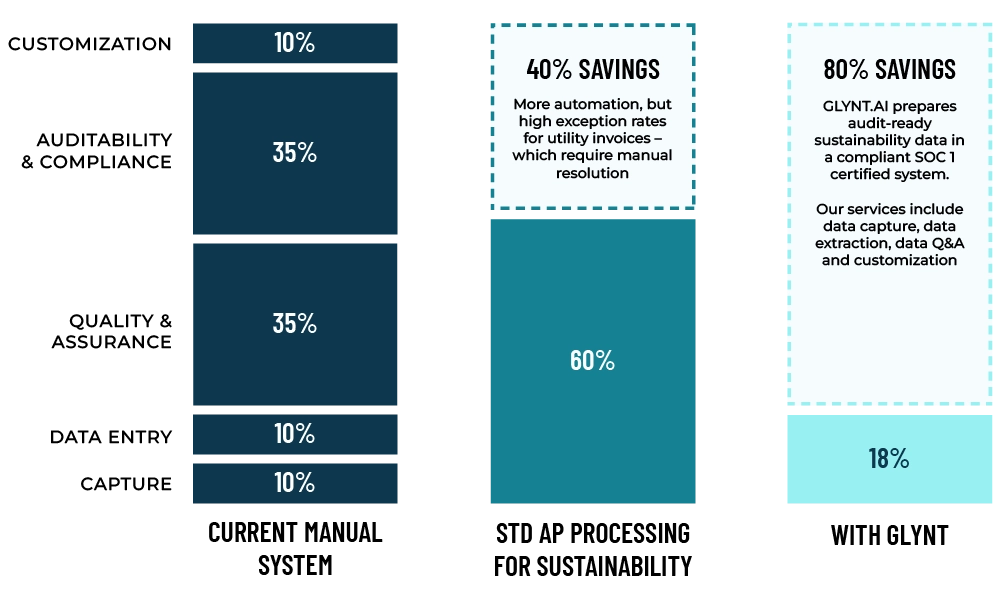
GLYNT.AI has built a data preparation cost calculator used with dozens of companies. We validate against their current costs and we compare our performance metrics to the leaders in Accounts Payable (AP) processing. Here’s a summary of typical results from GLYNT’s savings calculator.
Very simply: GLYNT.Al was built for this use case. We deliver better sustainability data faster and at less cost.
From Manual to Modern
Here’s how typical sustainability data preparations choices stack up
Want to see your savings?
About GLYNT.AI
GLYNT.AI is The Sustainability Data Company, preparing financial-grade sustainability data on water, waste, energy and emissions for businesses around the globe. Our SOC 1/SOX-level system delivers accurate, granular, audit-ready sustainability data at scale. Using a purpose-built machine learning system, the GLYNT system handles all data types and formats for water, waste, energy and emissions.
GLYNT.AI Offers
- 99.5% accuracy, guaranteed in our SLA
- 80% cost savings over current data preparation systems
- Sustainability data prepared in a a certified, compliant system, cutting audit time and expense
- Granular, validated data to build and track reduction plans
- Weekly, monthly or quarterly automated updates
- First data within a week, and a complete year of data in under 90 days
